You have sent applications, watched the status sit still, and started asking whether the problem is your CV, the market, or the way you are applying. The honest answer is that silence is common. It is also hard to interpret from one search, because there is no reliable UAE-wide database that publishes a candidate response rate by role, seniority and job board.
The most robust public benchmark we found is not UAE-specific. CareerPlug's 2025 recruiting-metrics report analysed 2024 hiring activity from more than 60,000 small businesses and over 10 million applications. It found that 3% of applicants were invited to interview. That does not predict your Dubai outcome. It does explain why sending 10 good applications and hearing nothing back is not, by itself, evidence that your search has failed.
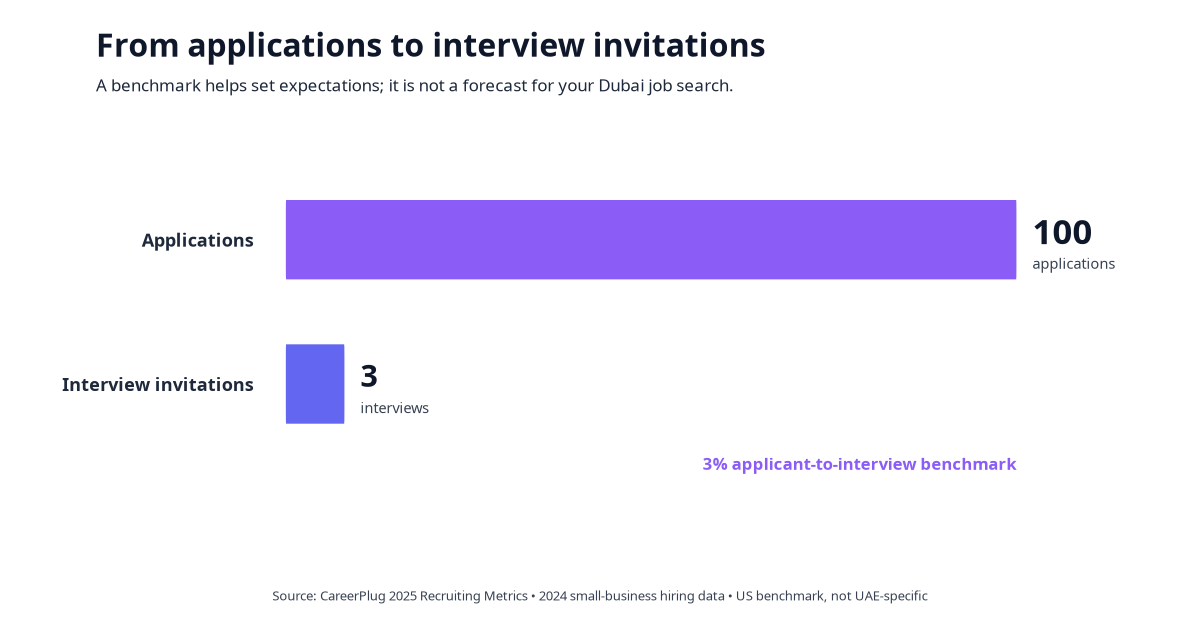
CareerPlug's 3% figure is a 2024 small-business benchmark, not a UAE response-rate forecast.
What percentage of job applications get a response?
Quick answer: There is no defensible UAE-wide answer. Use a benchmark as context, not a promise. CareerPlug's 3% applicant-to-interview figure means that, across its 2024 small-business data, roughly three people in every 100 applicants were invited to interview. Some Dubai roles will be more competitive; some will be much less. Your role, seniority, work authorisation, sector and the relevance of your application change the odds.
The distinction matters. A response rate is not an ATS score, a recruiter-read rate, or an offer rate. It is only one step: an application leading to an interview invitation. A low rate can reflect a crowded role, weak targeting, unclear evidence of fit, an incomplete application, a job that has already progressed internally, or factors you cannot observe from the applicant side.
If you have been told that ATS software rejects 75% of CVs before a human sees them, that claim is not supported by reliable evidence. For the full breakdown, read Do Applicant Tracking Systems Really Reject 75% of CVs?
How many applications should I send before worrying?
Quick answer: Do not reach a conclusion after a small sample. At a 3% benchmark, 25 applications would typically produce fewer than one interview. Instead of treating every quiet day as a verdict, assess whether you are applying to roles you can explain your fit for, whether your CV makes that fit visible quickly, and whether you are completing the application accurately.
Application benchmark
Am I on pace?
Enter the number of applications you have sent. The default example uses 25 applications.
Applications sent
At the 3% benchmark, 25 applications would typically produce fewer than one interview. This is context, not a prediction for your UAE search.
Source: CareerPlug 2025 Recruiting Metrics; 2024 U.S. small-business data, not UAE-specific.
Is applying to more jobs better?
Quick answer: More applications can still produce more interviews in total. The risk is allowing quality to fall while volume rises. Huntr's Q1 2026 platform data found an interview rate of 9.25% among users who sent 11-20 applications, compared with 2.58% among those who sent 100 or more. It is an observational, non-UAE dataset, so it does not prove that volume caused the difference. It is a useful warning against treating raw application count as the goal.
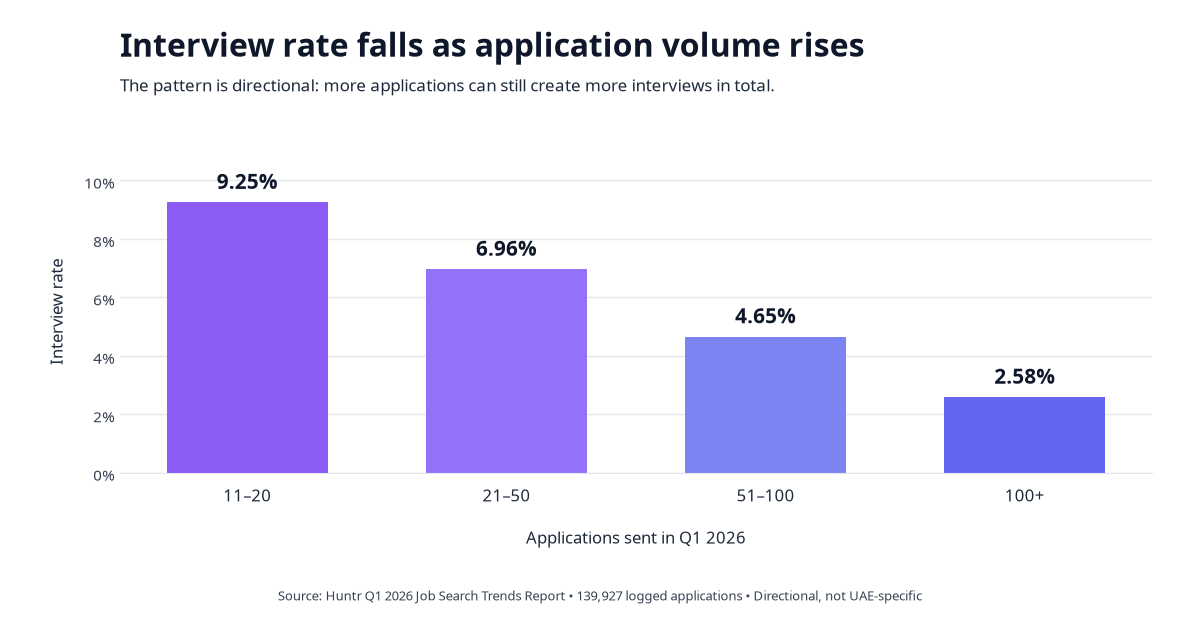
Huntr's reported Q1 2026 pattern is directional and non-UAE-specific; it does not mean candidates should stop applying.
The practical rule is not "apply less." It is "protect the quality of each application." Use a short list of target roles, prioritise the strongest fits, avoid applying to several unrelated jobs at one company, and keep a record of what you changed. For the wider evidence on targeted automation versus untargeted bulk applying, read what the evidence says about auto-apply.
Do you need to tailor your CV for each role?
Quick answer: Tailor the evidence, not the truth. Your job title, opening summary, selected skills and achievement bullets should make the relevant part of your real experience easy to recognise. Do not manufacture terms, credentials or outcomes simply because they appear in a job description.
There is some UAE-specific context, but it is dated. In a 2021 Michael Page survey of 635 UAE job applicants, 20% said they adapted their CV for every role, 25% did so most of the time and 26% sometimes. That is an indicative, pandemic-era self-report survey, not a current market measurement. It does show that candidates already understood tailoring as a way to make their fit legible.
Huntr's newer but non-UAE platform data points in the same direction: applications using a resume tailored through its workflow were associated with a 4.23% interview rate, versus 2.07% for its base or externally edited resume group. Because Huntr defines and produces the tailored resumes, and because candidates choose how to use the tool, this is an observed association rather than causal proof. The useful lesson remains straightforward: use your CV to make the most relevant experience obvious.
Why do applications in Dubai feel harder than elsewhere?
Quick answer: The evidence does not support a single UAE-wide ranking of difficulty. A search in Dubai can span LinkedIn, regional boards, recruiter channels and employer career sites, each with a different application flow and candidate pool. The 2021 Michael Page survey found LinkedIn used by 59% of its UAE respondents, alongside employer websites, recruitment consultancies and job boards. That fragmentation can create a lot of repeated work without necessarily improving fit.
A better diagnostic is to separate access from conversion. Access means you are finding roles across the relevant sources. Conversion means your application makes a credible, easy-to-scan case for the particular role. If access is the bottleneck, centralising connected sources can help; our guide to the best AI job-application tools for the UAE explains why board coverage varies. If conversion is the bottleneck, choose fewer high-fit roles and make the case for each one clearer.
How long should a job search take?
Quick answer: Plan for a process rather than a deadline. Huntr reported a 108-day median from search start to first offer in its Q1 2026 user data. Separately, a Clarify Capital survey of 1,000 Americans reported about nine hours a week spent searching and applying by unemployed respondents, and five hours by those searching while employed. Neither is a UAE forecast. Together, they are a reminder that the most useful system is the one you can sustain weekly.
Set a weekly rhythm: find relevant roles, choose the best fits, tailor the parts of your CV that establish relevance, complete forms carefully, and record responses. Revisit the process after a meaningful set of applications rather than revising everything after one quiet week.
What does a recruiter see first?
Quick answer: They need to see a relevant story quickly. CNBC reported one former Disney recruiter's view that an initial resume scan can take three to five seconds. That is professional judgement, not a controlled study, but it points to a sound design test: can a reader spot your current or recent title, employer context, relevant skills and evidence of impact without hunting for them?
Before sending the next application, check the signal: not just the keyword count.
| Check | What a strong version looks like |
|---|---|
| Target role | You can explain why this role fits your actual experience in two sentences. |
| Opening third of CV | Your title, relevant scope and strongest evidence appear without a recruiter needing to infer them. |
| Skills | Skills are supported by work examples, not only repeated in a keyword list. |
| Application form | Eligibility and screening answers are complete, accurate and consistent with your CV. |
Should you rewrite your CV?
Quick answer: Rewrite the framing when it helps a real match become visible. Keep your factual work history unchanged, but make the relevant achievements, tools and scope easier to see. A tailored CV should be more specific, not more fictional.
If you are spending your search time switching between boards and repetitive forms, 1000Jobs can bring roles from connected sources into one workspace, score them against your profile and help you prioritise the strongest matches. Start with 100 free credits, then use your own interviews and time spent as the measure of whether the process is helping. For the time-cost comparison, see 1000Jobs versus applying manually in the UAE.
Frequently asked questions
What percentage of job applications get a response?
There is no reliable UAE-wide response-rate benchmark. CareerPlug's 2024 small-business hiring data found that 3% of applicants were invited to interview. It is a useful benchmark for setting expectations, but it is US-oriented and does not predict the outcome of a Dubai application.
How many applications should I send before worrying?
Do not judge the search after a handful of applications. At a 3% benchmark, 25 applications would typically produce fewer than one interview. Review your targeting, CV relevance and application quality before simply increasing volume.
Is applying to more jobs better?
More applications can create more interview opportunities in total, but high volume does not guarantee a higher interview rate. Huntr's Q1 2026 platform data showed lower interview rates in its 100-plus-application group than in its 11-to-20 group. That is an observational, non-UAE pattern, so treat it as a reason to protect quality rather than as a rule to apply less.
Do most people in the UAE tailor their CV for each role?
An indicative Michael Page survey of 635 UAE job applicants in 2021 found that 20% adapted their CV for every role, 25% did so most of the time and 26% sometimes. The survey is dated and self-reported, so it is not a current market measurement.
Why do UAE applications feel harder than elsewhere?
There is no single UAE-wide measure proving that applications are harder. A UAE job search can involve LinkedIn, regional boards, recruiter channels and company career sites, so relevance and a clear application process matter. The useful comparison is your own interview rate and the quality of the roles you are targeting, not a universal league table.
How long does a job search take?
The answer varies by role, seniority, sector and market. Huntr reported a 108-day median from search start to first offer in its Q1 2026 user data, while a U.S. Clarify Capital survey found unemployed respondents spent about nine hours a week job searching. Neither number is a UAE forecast, but both show why a repeatable weekly process matters.
Is there a tool that searches all the UAE job boards at once?
No tool should promise complete coverage of every UAE job board or employer site. 1000Jobs brings roles from connected regional boards, LinkedIn and company career sites into one workspace, then helps you prioritise the matches that merit action. Check a tool's current source coverage before relying on it for a specific search.
Should I rewrite my CV?
Rewrite the parts that establish fit for the specific role: your headline, opening summary, relevant skills and achievement bullets. Keep factual experience intact. Tailoring should clarify your real experience against the job description, not invent keywords or credentials.
Sources and method
There is no public, representative UAE dataset that supports a precise claim such as "Dubai applicants receive X% interview responses." This article therefore uses a UAE survey only for dated, indicative candidate behaviour and labels broader figures by their original population. Vendor and survey data are useful context, not independent causal proof or a personalised prediction.
- CareerPlug, "2025 Recruiting Metrics Report: Benchmark Data & by Industry" — 2024 small-business hiring data; 3% applicant-to-interview benchmark.
- Huntr, "The Q1 2026 Job Search Trends Report" — first-party application, resume and survey data; directional and self-reported outcome limitations.
- Michael Page UAE, "Almost half UAE job seekers use their mornings to apply for new roles" — 2021 survey of 635 UAE job applicants; indicative only.
- Clarify Capital, "How Much Time and Money It Takes to Find a Job Today" — U.S. survey of 1,000 Americans.
- CNBC, "Hiring managers spend '3-to-5 seconds' on your resume" — a former recruiter's professional judgement, not a controlled study.