Quick answer: If you are a full-time foreign worker in the UAE private sector and complete at least one year of continuous service, you are generally owed end-of-service gratuity. It is 21 days of basic salary for each of the first five years and 30 days for each year after that, capped at two years of basic salary.
If you have ever searched for a UAE gratuity calculator, you may have noticed something confusing: two calculators can give you different numbers. That does not always mean one of them is broken. Differences can come from the dates entered, the service period, the work pattern, or how a particular calculator handles partial years.
This guide is meant to help you do more than enter a salary and copy a number. I checked the current UAE Labour Law, Federal Decree-Law No. 33 of 2021, and several existing calculators so you can understand where the number comes from and what you should check before treating it as your final entitlement. The legal rules in this guide were checked on 10 November 2026.
What is gratuity and who gets it?
For the standard UAE private-sector rules, gratuity is an end-of-service benefit for eligible employees, and a full-time foreign worker becomes entitled to it after at least one year of continuous service, according to the UAE Government’s end-of-service guidance. The current rules distinguish between UAE nationals and foreign workers. UAE nationals working in the private sector have end-of-service benefits under the legislation governing pensions and social security, rather than the standard expatriate gratuity formula discussed in this calculator guide.
For a full-time foreign worker, the important starting point is one year of continuous service. If service is less than one year, the standard gratuity is not due. Once the one-year requirement has been met, a fraction of a year can be included proportionately. Unpaid days of absence are not included in the service period used for the calculation.
How the UAE gratuity formula works
The standard full-time formula uses the employee’s last basic salary, not the full salary package. The rate is 21 days of basic salary for each year of the first five years of service, followed by 30 days of basic salary for each year after five years. The total gratuity is capped at two years of basic salary.
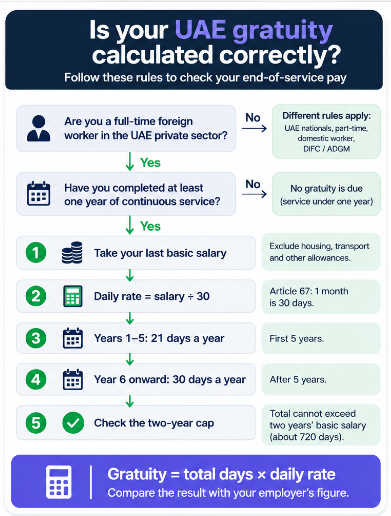
The basic formula is:
- First 5 years: 21 days of basic salary for each year.
- After 5 years: 30 days of basic salary for each additional year.
- Partial years: calculated proportionately once the employee has completed at least one year.
- Maximum: total gratuity cannot exceed two years of basic salary.
Article 51 of the law says the calculation is based on the last basic salary for monthly, weekly or daily-paid workers. Allowances such as housing and transport are therefore not part of the standard gratuity calculation when they sit outside the basic salary.
For the worked examples in this article, I use monthly basic salary divided by 30 to get a daily rate. This matches the method used by the major calculators checked for this article, and Article 67 of the Labour Law defines a month as 30 days for calculating periods and dates.
Why can two gratuity calculators show different numbers?
The first thing to check is what the calculator is actually asking you to enter. The Dubai Development Authority calculator asks for the first working day, last working day and basic salary, and clearly says that its result is an estimate for guidance rather than a final, legally binding amount. The Khaleej Times calculator similarly uses basic salary and employment dates and explains its calculation using a daily wage and service period.
The bigger issue is partial service. Once you are working with months and days rather than an exact whole number of years, calculators have to convert that period into a proportional amount. They may also differ in the way they collect dates or handle work patterns. That is why the safest approach is to understand the formula and compare the inputs, rather than choosing the biggest number.
What would you get? Worked examples
The examples below are illustrative only. They are not average UAE salaries and they are not quotes from employers. I am using the standard full-time foreign-worker formula and assuming the employee has completed at least one year of continuous service, with no unpaid absence affecting the service period.
Example 1: AED 4,000 basic salary, 2 years
All service is within first five years
Daily basic salary: AED 4,000 ÷ 30 = AED 133.33
Calculation: 21 × (4,000 ÷ 30) × 2 = 5,600.00
Illustrative gratuity: AED 5,600.00
Example 2: AED 8,000 basic salary, 4 years 11 months
All service is within first five years; the final 11 months are pro-rated
Daily basic salary: AED 8,000 ÷ 30 = AED 266.67
Calculation: 21 × (8,000 ÷ 30) × 4 + 21 × (8,000 ÷ 30) × (11 ÷ 12) = 27,533.33
Illustrative gratuity: AED 27,533.33
Example 3: AED 15,000 basic salary, 5 years
Exactly five years
Daily basic salary: AED 15,000 ÷ 30 = AED 500.00
Calculation: 21 × (15,000 ÷ 30) × 5 = 52,500.00
Illustrative gratuity: AED 52,500.00
Example 4: AED 30,000 basic salary, 8 years 3 months
First five years at 21 days; remaining 3 years 3 months at 30 days
Daily basic salary: AED 30,000 ÷ 30 = AED 1,000.00
Calculation: 21 × (30,000 ÷ 30) × 5 + 30 × (30,000 ÷ 30) × 3.25 = 202,500.00
Illustrative gratuity: AED 202,500.00
Example 5: AED 8,000 basic salary, 15 years
First five years at 21 days; remaining ten years at 30 days
Daily basic salary: AED 8,000 ÷ 30 = AED 266.67
Calculation: 21 × (8,000 ÷ 30) × 5 + 30 × (8,000 ÷ 30) × 10 = 108,000.00
Illustrative gratuity: AED 108,000.00
The same method can be used with your own basic salary and service dates. Remember that an actual calculation can be affected by unpaid absence, work pattern, lawful deductions, special employment regimes and the exact date calculation used by the applicable authority.
When does the two-year cap actually matter?
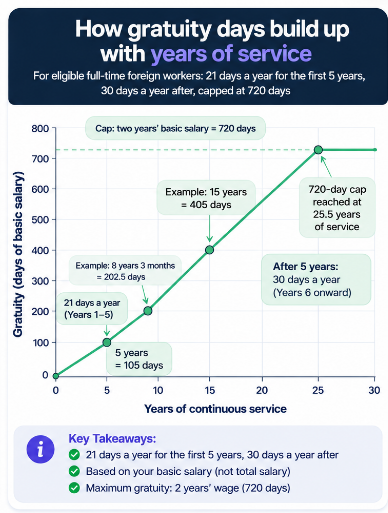
The two-year cap is 720 days of basic salary when a month is counted as 30 days. The first five years give 105 days, and the remaining 615 days take another 20.5 years at 30 days per year. So the cap only starts to bite at roughly 25.5 years of service, which means it never applies to most employees.
Does resigning change your gratuity?
Under the current standard private-sector rules, resignation does not create a separate reduced gratuity formula once an eligible full-time foreign worker has completed at least one year of continuous service. The current Article 51 formula is tied to service length and basic salary rather than a resignation percentage, as the UAE Government’s guidance also explains.
This matters because older UAE gratuity articles still appear in search results, and many repeat a rule that no longer applies: that an employee on an unlimited contract who resigned after one to three years would receive only one-third of the calculated gratuity, and two-thirds after more than three years and up to five years. That was the position under the old Federal Law No. 8 of 1980. It was replaced by Federal Decree-Law No. 33 of 2021, which does not apply those resignation reductions and should be the starting point for a 2026 calculation.
Resignation still does not mean every other payment disappears. Notice obligations, final wages, unused leave and any lawful deductions are separate parts of the final settlement and should be checked separately. If you are resigning to move jobs and your applications are going unanswered, our guide to why Dubai job applications get ignored explains what may be going wrong.
What is included in your final settlement?
Gratuity is only one part of your UAE final settlement. Under Article 53 of the UAE Labour Law, employers must pay the worker’s wages and other due entitlements within 14 days from the end of the employment contract. Your final settlement may include unpaid salary, gratuity, compensation for unused annual leave, and other applicable contractual entitlements. Unused annual leave compensation is separate from gratuity and is generally calculated based on the worker’s basic salary.
Before accepting your final settlement, ask for a written breakdown of how each amount was calculated. This can help you check whether your employer’s calculation matches your entitlements.
What if your employer does not pay your gratuity?
If your gratuity or other final dues are not paid, or you believe the amount is incorrect, you can file a labour complaint with the Ministry of Human Resources and Emiratisation (MOHRE). MOHRE can first attempt to resolve the dispute amicably and may refer unresolved cases to the competent court, as set out in the UAE Government’s labour dispute guidance. You can contact MOHRE through its Labour Claims and Advisory Call Centre at 80084, website, or mobile app. Check the latest MOHRE instructions before filing, as complaint procedures and requirements may change.
Keep important documents such as your employment contract, salary records, final settlement statement, resignation or termination documents, and communication about unpaid dues. These can help support your complaint and explain the issue clearly.
What is the UAE End-of-Service Savings Scheme?
The UAE has a voluntary alternative to the traditional end-of-service gratuity system called the Savings Scheme. Employers can opt into the scheme and select employees or employee groups to participate. For employees covered by the scheme, the employer makes monthly contributions to approved investment funds instead of continuing the traditional gratuity arrangement for the period covered by the scheme.
For full-time employees, the employer contribution is 5.83% of monthly basic salary for employees with less than five years of service and 8.33% for employees with five years or more of service. Gratuity accrued before joining the Savings Scheme must also be calculated and settled separately.
The Savings Scheme does not replace the traditional UAE gratuity calculation for everyone. It applies only to employers and employees covered by the scheme, while the traditional gratuity system remains relevant for employees outside the scheme and for benefits accrued before participation.
What about part-time, domestic, DIFC and ADGM workers?
The standard UAE gratuity calculation should not automatically be applied to every worker. Part-time and job-sharing employees have a separate calculation method under Article 30 of Cabinet Resolution No. 1 of 2022, based on their contractual working hours compared with a full-time employee, as theUAE Government’s guidance explains. The one-year rule applies whatever the contract type: if you have completed less than one year of service, no end-of-service gratuity is due.
Domestic workers are covered by separate legislation, so their end-of-service benefits should be checked using the rules that apply specifically to domestic employment, including MOHRE’s official Domestic Workers Dues Calculator.
DIFC and ADGM employees are also special cases. These financial free zones have separate employment regulations from the standard UAE federal private-sector framework. Employees working under DIFC or ADGM rules should therefore check the applicable authority’s regulations before using a general UAE gratuity calculator.
Which official gratuity tools can you use?
An online UAE gratuity calculator can help you estimate your end-of-service benefit, but the result should always be checked against the applicable law and your employment details.
The Dubai Development Authority provides an online gratuity calculator that asks for details such as your first working day, last working day and basic salary. The calculator states that its result is for guidance and sample calculation and is not a final or legally binding determination.
There is no general official MOHRE gratuity calculator for private-sector employees. Some websites use MOHRE’s name to look official, but MOHRE itself does not run a general gratuity calculator. MOHRE and the UAE Government do publish official information on end-of-service benefits, along with services for employment complaints and other labour matters.
If you have lost your job, the official ILOE compensation calculator is a separate tool for the other money that may be due when a job ends. It estimates potential unemployment-insurance compensation and is not a gratuity calculator.
For UAE private-sector employees, it is best to use official government guidance as the primary source and an online gratuity calculator as a calculation check.
Why is it difficult to estimate gratuity before you get an offer?
Most UAE job listings do not provide enough salary information to estimate your future gratuity while you are still job hunting. In fresh 1000Jobs UAE pool analysis covering October 2026, a structured salary field was present in 490 of 17,725 listings collected in October 2026, 2.8 per cent. See our UAE job listings reports for the wider data.
This means that, for most listings, you cannot work out your future gratuity from the listing alone. Your gratuity depends on the basic salary in your employment arrangement, which may only become clear when you receive an offer and review your employment terms. That is why understanding the UAE gratuity calculation and how the basic salary affects it is useful before accepting a job.
If you are comparing roles while you search, our guides to the best AI job application tools for the UAE and how 1000Jobs compares with applying manually cover how to search more efficiently.
Method and limitations
This article was checked against Federal Decree-Law No. 33 of 2021 and the UAE Government’s guidance on end-of-service benefits. We also compared how current UAE gratuity calculators explain their inputs and calculations. The legal rules in this article were checked on 10 November 2026.
The calculation examples use illustrative salaries only. They explain how the UAE gratuity calculation works and are not predictions of what a specific employee will receive. Actual entitlements can depend on service dates, unpaid absence, work pattern, lawful deductions, the applicable employment regime and valid employer arrangements.
This article provides general information and is not legal advice. If your gratuity calculation is disputed or your employment falls under a special regime, check the latest guidance from MOHRE, the relevant free-zone authority, or a qualified adviser.
Sources and data notes
- MOHRE – Federal Decree-Law No. 33 of 2021, as amended: official government document; Article 51 (gratuity), Article 53 (payment within 14 days) and Article 67 (calendar calculation). Checked 10 Nov 2026.
- UAE Government – End of service benefits for workers in the private sector: official page; current guidance on eligibility, basic salary, payment timing, part-time workers and the Savings Scheme. Checked 10 Nov 2026.
- UAE Government – Cabinet Resolution No. 96 of 2023: official page; Alternative End-of-Service Benefits System / Savings Scheme. Checked 10 Nov 2026.
- UAE Government – Cabinet Resolution No. 1 of 2022: official page; Article 30, part-time and other work patterns. Checked 10 Nov 2026.
- Federal Law No. 8 of 1980 (repealed): used only to describe the old one-third and two-thirds resignation rules that no longer apply.
- Khaleej Times – UAE Gratuity Calculator 2026: calculator structure and explanation of daily wage, service period and formula. Checked 10 Nov 2026.
- Dubai Development Authority – Online Gratuity Calculator: official calculator inputs and disclaimer. Checked 10 Nov 2026.
- Gulf News – UAE gratuity guide (31 Oct 2026): recent explainer used for practical final-settlement context and cross-checking the current rule. Checked 10 Nov 2026.
- UAE Government – Resolving labour disputes: official page; current MOHRE complaint process and dispute resolution information. Checked 10 Nov 2026.
- MOHRE Labour Market Observatory – Communication Channels: official page; current Labour Claims and Advisory Call Centre number and channels. Review dated 22 Jul 2026. Checked 10 Nov 2026.
- UAE Government – Savings Scheme overview: official page; current overview of participation, contribution rates, accrued gratuity and entitlements under the scheme. Checked 10 Nov 2026.
- MOHRE – Domestic Workers Dues Calculator: official calculator for domestic workers’ end-of-service dues, separate from the private-sector formula.
- ILOE – Compensation calculator: official unemployment-insurance calculator, separate from gratuity.
FAQ
How is gratuity calculated in the UAE?
For a covered full-time foreign private-sector worker who has completed at least one year of continuous service, gratuity is calculated using the last basic salary. The rate is 21 days of basic salary for each of the first five years and 30 days for each year after five years. Part years are calculated proportionately, subject to the applicable maximum of two years of basic salary.
Is gratuity calculated on basic salary or total salary?
The standard full-time UAE gratuity calculation is based on the last basic salary, not the total salary package. Allowances such as housing and transport are generally not included when they are separate from the basic salary.
Do I get gratuity if I resign?
Generally, yes. A covered full-time foreign worker who has completed at least one year of continuous service can be entitled to gratuity when resigning. Under the current standard formula, resignation does not create a separate reduced gratuity rate.
What is the maximum gratuity in the UAE?
For a full-time foreign worker covered by Article 51, end-of-service gratuity cannot exceed two years of basic salary.
When must my employer pay gratuity?
The employer must pay the worker’s wages and other end-of-service entitlements within 14 days from the end date of the contract term.
What if my employer does not pay gratuity?
You can raise a labour complaint with MOHRE through its current complaint channels, including its website, mobile app and Labour Claims and Advisory Call Centre at 80084. MOHRE may first attempt an amicable settlement and can refer unresolved disputes to the competent court. Check the latest filing procedure before submitting a complaint.