Quick answer: Yes, you can apply to UAE jobs from abroad or after arriving on a job seeker visa, and many employers in the UAE hire people without local experience. They are looking for the right skills, not a UAE work history. Add your visa status, current location, and transferable skills to your CV, tailor it to each role, and search across LinkedIn, company career sites, Bayt, GulfTalent, and your network. Managing several job boards while tailoring each CV by hand can eat 50+ hours per 100 applications, and 1000Jobs consolidates the search and handles the repetitive tailoring, so you spend that time on quality applications instead.

Most job ads in the UAE seem to ask for something you cannot have yet: local experience. If you are applying from abroad, or you have just landed, the worry is that every CV without a UAE work history goes to the bottom of the pile. It does not. This guide covers what employers in the UAE actually check, which visa lets you search before you move, where the jobs are, and how to present a CV with no local experience.
Do I need UAE experience to get hired?
No, and the listings show it. In our August-September 2026 analysis of 25,320 unique UAE job listings, 12,137 (47.9%) mentioned an experience requirement, so just over half state none. Those requirements are a number of years, not UAE experience specifically, so experience anywhere normally counts. A direct phrase search of the same window found only 1,359 of 25,320 listings (5.4%) explicitly ask for UAE, local, or GCC experience, usually as a preference. These are what listings say, not who gets hired; where none is stated, UAE experience cannot be a hard gate.
What employers in the UAE actually want is a skill match: the right technical or industry skills, the tools you already use, and evidence that you deliver. They also weigh practical factors: where you are now, how soon you can start, and how quickly you understand the market. If you are abroad, say so plainly in your CV header and give a realistic start date. If you have visited, hired, or worked in the Gulf before, mention it.
If an interviewer asks whether you have UAE experience, answer directly, then pivot to the closest evidence you have: similar wins in another market, the local regulations or clients you already know, and how quickly you have ramped up in new environments before. The question tests readiness, not your right to be in the process.
Can I look for a job in the UAE before I move?
Yes. You can apply online from abroad, and many employers interview remotely. Some roles prefer candidates who can start quickly or attend in person, so expect a slightly lower response rate from overseas, not a closed door.
A practical approach: start applying from home to build momentum. Once you have interviews lined up or you feel ready, travel to the UAE and interview in person. This saves money and keeps your search active.
If you are already in the country on a visit visa, use the time for interviews and networking. You cannot legally work on a visit visa, so plan around the visa you hold and the notice period you have.
Which visa can I use to look for a job in the UAE?
The job seeker visa is designed exactly for this. You do not need a sponsor, and you can stay for 60, 90 or 120 days. To qualify, you typically need:
- a bachelor's degree or equivalent, and
- either a job role classified as skill level 1, 2, or 3 by the UAE Ministry of Human Resources and Emiratisation (MOHRE), or a degree from a top-500 university completed within the last two years.
How do I apply for a UAE job seeker visa?
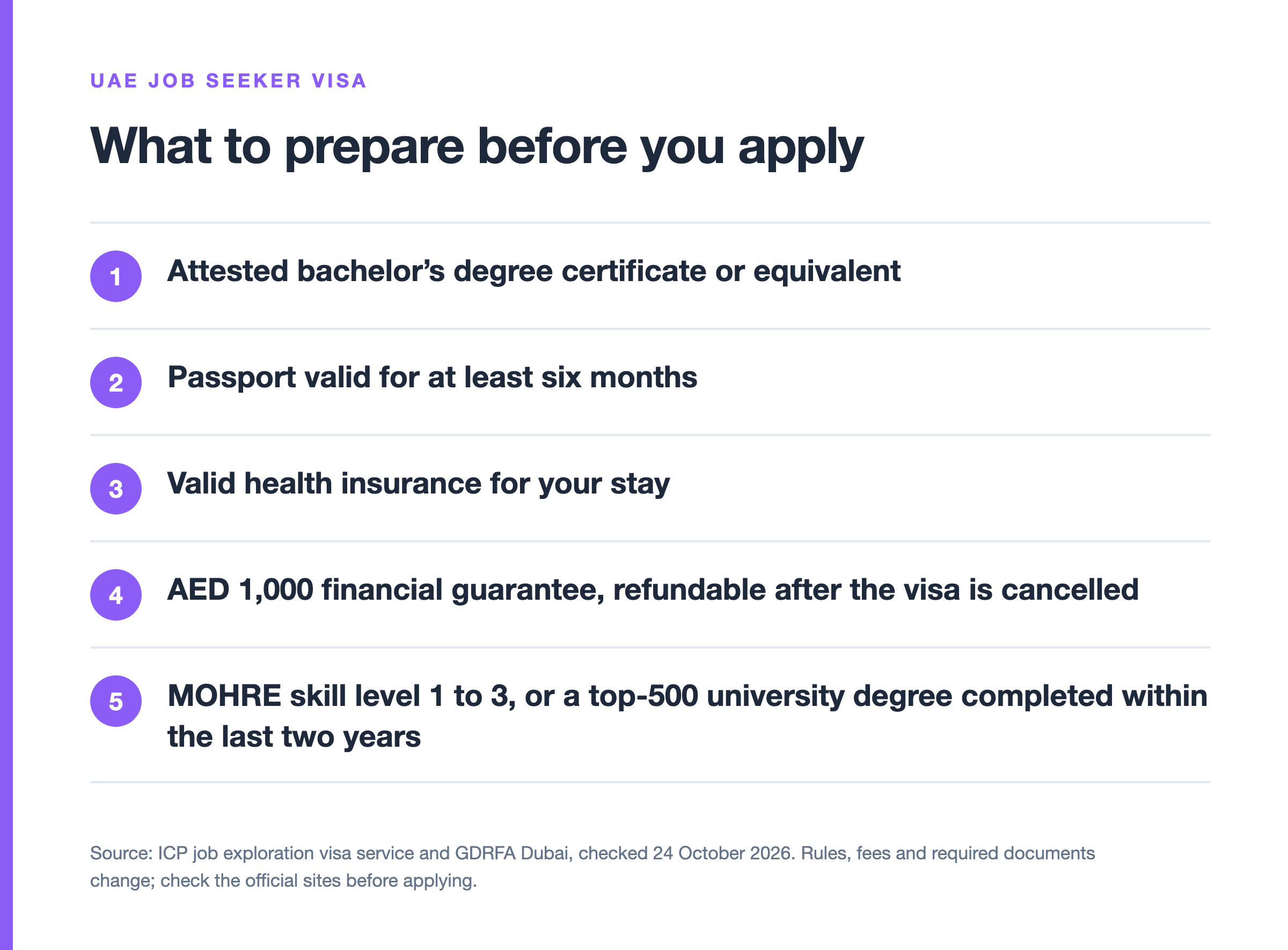
Applications go through the ICP job exploration visa service for most emirates or the GDRFA Dubai visit visa for job exploration for Dubai. You need an attested degree certificate, a passport valid for at least six months, valid health insurance for your stay, and a financial guarantee (AED 1,000 under the current ICP fee schedule, refundable after the visa is cancelled). Rules, fees, and required documents change, so check the official ICP or GDRFA website before applying. Requirements checked 24 October 2026.
A regular tourist or visit visa also lets you attend interviews and network, but you cannot legally work on it.
What happens after I get hired?
Once you are hired, your employer applies for your employment visa and work permit, which usually includes an entry permit, medical tests, and an Emirates ID application. Your job seeker visa can usually be converted without you leaving the country, though this varies by emirate. Ask your employer's HR team for details.
Where should I look for jobs in the UAE?
You should not have to search five different places to cover one market. UAE listings are scattered across sources that each see only part of it: LinkedIn, regional boards like Bayt and GulfTalent, and company career pages. Our detailed comparison of UAE job boards and their best uses explains which platforms matter most for your target role.
Here is where to start:
- LinkedIn: where a large share of UAE job postings appear. LinkedIn Easy Apply is widely used and also the most competitive route, so tailor your CV for every Easy Apply application and apply early in the posting's life.
- Company career sites: many large employers post roles on their own hiring systems (Workday, Greenhouse, SmartRecruiters and others). Check the careers pages of companies you want to work for. If a career page hands you to Workday or another applicant tracking system, that is normal.
- Regional job boards: Bayt, GulfTalent, and Naukrigulf are widely used in the UAE, and carry many roles that never appear on LinkedIn. Each has different strengths depending on your sector.
- Recruitment agencies: useful in some sectors. Check that the agency is licensed, and never pay a fee (see the scams section below).
- Your network: referrals remain one of the most effective ways to get hired. Tell friends, former colleagues, and alumni in the UAE that you are looking.
You do not need to search those channels yourself. 1000Jobs collects listings from LinkedIn, Bayt, GulfTalent, Naukrigulf, and company career sites, so the roles from those sources sit in one place. It is not a searchable database to dig through: the jobs come tailored to you, AI-matched to your profile so you only see roles that fit your experience and eligibility.
No more switching between tabs or missing roles you did not check that day. Start with 100 free credits to see how the matching works for your profile. If you prefer to search manually, treat it as a weekly routine: a fixed block each week beats occasional bursts, because listings move fast and many roles collect applications on a rolling basis.
You still decide what to apply for, but the tool handles the repetitive searching so you can focus on quality applications.
If you are comparing tools before committing, our comparison of AI job application tools for the UAE covers which ones actually reach Gulf job boards.
How do I make my CV right for UAE employers?
UAE employers expect a few things that CVs in other countries often leave out, and the header is where you neutralise the no-local-experience worry. What to include in a UAE resume covers the full layout. At minimum, put these in:
- Personal details at the top: your nationality, visa status (or visa eligibility), current location, and notice period or availability date. Employers want to know where you are and when you can start.
- Languages, with your proficiency level. A language requirement was mentioned in 5,127 of 25,320 UAE job listings we analysed from August to September 2026 (20.3%), often Arabic. If you speak it, flag this, and see Do I Need to Know Arabic to Get a Job in the UAE? for how much it actually matters.
- A UAE driving licence, if you have one and the role involves travel. A driving licence was mentioned in 1,232 of 25,320 listings (4.9%) in the same analysis.
- Clear job titles and dates, and results backed by numbers where possible. Show impact, not just tasks.
Then tailor your CV to each job description. Our 6-step tailoring guide walks through how, and tailoring matters because screening software reads your CV before a recruiter does. Mirror the exact skill and tool keywords from the job description: how applicant tracking systems actually work and what an ATS can and cannot reject explain the mechanics.
How do I explain missing UAE experience on my CV?
You can pre-empt the question in two places: your summary and the requirement-mapping. In your summary, lead with your strongest transferable result and your availability, not a generic objective. And where a job description lists a requirement you meet in another market, say so explicitly: regulated payroll processing in the UK maps to UAE payroll in a recruiter's mind far better than a bare job title does. Which applicant tracking systems appear most often in UAE job listings shows where your CV is likely to be parsed first.
Tailoring your CV to each role is the most painful and time-consuming part of the search. 1000Jobs rewrites your CV for every role you match to, so every application goes out tailored without wasting hours on editing. You still decide what to apply for; the repetitive tailoring is done automatically. Start with 100 free credits, no card, no commitment.
How long does it take to find a job in the UAE?
It varies widely by industry, seniority, and target market. Many newcomers take several weeks to a few months from first application to signed offer, and the visa stage after the offer adds more time.
Expect the search to move in stages: applications in week one, first responses and interviews over the following weeks, then an offer followed by the visa process. If months pass with no response at all, the fix is usually targeting and CV fit rather than volume. The Real Reasons Your Dubai Job Applications Are Getting Ignored explains what happens on the employer's side.
To avoid running out of time or money:
- Plan your budget to cover your stay for longer than you expect.
- Start applying before you arrive in the UAE, so you have interviews lined up or momentum built.
- Apply steadily, with a tailored CV for each role, rather than in occasional bursts. Consistency matters more than volume, and the evidence on bulk applying shows why.
- Follow up politely on applications and interviews after a week.
How do I avoid job scams in the UAE?
Fake job offers actively target newcomers and get more convincing every year. Warning signs include:
- A request for money: legitimate employers never ask you to pay for a job offer, visa, training, or processing fees.
- An offer without a real interview, or after only a brief chat on WhatsApp or Telegram.
- Personal email addresses (such as Gmail or Yahoo) instead of a company domain.
- A request for passport copies or bank details before any formal interview or offer.
- Pressure to decide or pay quickly.
- A salary that seems too good for the role and market.
If you are unsure, verify the company on its official website and LinkedIn, and contact it directly using contact details from its official site, not from the job posting. If a recruiter asks you to pay anything, stop the conversation: no licensed agency in the UAE charges job seekers.
Method and limits
The analysis covers unique job postings collected across LinkedIn, Bayt, GulfTalent, Naukrigulf, and company career sites where we have tracking coverage, not every vacancy in the market. Collection was reduced on some days in September, so month totals reflect what was collected; requirement shares are read from each listing's text and are comparable across both months.
The August-September 2026 figures come from a 1000Jobs UAE pool analysis of 25,320 unique listings (provider-posted, UAE-filtered, application link present, deduplicated to one record per canonical application URL): 14,975 posted 1 to 31 August 2026 and 10,345 posted 1 to 30 September 2026. The language figure (5,127 of 25,320 listings, 20.3%) and the experience figure (12,137 of 25,320 listings, 47.9%) measure requirements explicitly mentioned in the listing text. They describe listings, not hiring decisions or the whole market. The UAE-experience figure is a phrase search of the same window.
Visa information is general guidance based on published requirements checked on 24 October 2026. Rules, fees, and required documents change regularly. Always check the official ICP or GDRFA website before applying for any visa.
Sources and data notes
Listing and language data come from the 1000Jobs UAE listing pool (August to September 2026, 25,320 unique listings); volume figures cover only the sources we track. Visa requirements were checked on 24 October 2026.
- Where to Actually Find Jobs in Dubai (And Which Sites Waste Your Time) - platform-by-platform comparison for UAE job seekers.
- How Long Does It Take to Apply to 100 Jobs Manually in the UAE? - the research behind the 50+ hours per 100 applications figure.
- Do People Actually Get Jobs Using LinkedIn Easy Apply? - how competitive Easy Apply is in the UAE.
- How to Tailor Your CV for UAE Jobs: 6-Step Guide (2026) - the CV tailoring workflow used in this guide.
- ICP: Issuance of a Job Exploration Visa - official requirements and application route for most emirates.
- GDRFA Dubai: Issuance of a Visit Visa for the Purpose of Exploring Employment Opportunities - official application route for Dubai.
- Arabian Business: UAE jobseeker visa guide - eligibility, validity and costs when the jobseeker visa rules took effect.
Frequently asked questions
Can I get a job in the UAE without being there?
Yes. Many employers in the UAE hire candidates who apply from abroad, and most first interviews run remotely. Your chances improve once you can interview in person or start quickly, so apply from home first and travel when interviews line up.
What is the UAE job seeker visa?
The UAE job seeker visa lets eligible candidates stay in the country for 60, 90 or 120 days to look for work without a sponsor. You typically need a bachelor's degree and either a role classified at MOHRE skill level 1, 2 or 3 or a degree from a top-500 university completed in the last two years. Check the official ICP or GDRFA website for current requirements.
Can I work on a visit visa?
No. A tourist or visit visa lets you attend interviews and network, but you need an employment visa and work permit, arranged by your employer, before you start work.
Do I have to pay a recruitment agency?
No. Legitimate recruitment agencies do not charge job seekers in the UAE. Treat any request for a fee, deposit, or processing payment as a job scam.
How many UAE job listings are posted each week?
We can only answer for the listings we collect: 14,975 in August 2026 and 10,345 in September 2026, across LinkedIn, Bayt, GulfTalent, Naukrigulf, and company career sites. That is what we observe, not every vacancy posted in the market.
If I don't speak Arabic, does that hurt my chances?
No. A language requirement, often Arabic, was mentioned in 5,127 of 25,320 UAE job listings we analysed from August to September 2026 (20.3%), so most listings name no language requirement. Highlight Arabic if you speak it, and focus on roles where it is not required if you do not.